Why Direct Mail Is Winning Again in a Digital-First World
The issue isn’t always the message. It’s the channel.
As marketers, we’ve all felt it—getting attention online is harder than ever.
-
Inbox fatigue is real.
-
Spam filters are more aggressive.
-
Even strong email campaigns often go unseen.
The issue isn’t always the message—it’s the channel. That’s why we’re seeing a clear shift back toward direct mail. At National Graphics, we’ve watched clients rediscover something that digital channels struggle to deliver today: visibility. Direct mail works for one simple reason—it actually gets seen.
-
It doesn’t get filtered.
-
It doesn’t get buried.
-
And it doesn’t disappear with a swipe.
Instead, it sits—on desks, kitchen counters, and offices—creating multiple opportunities for engagement.
Data doesn't lie.
The data supports it. Direct mail boasts higher response and engagement rates compared to digital channels. Consumers are more likely to trust and engage with something they can physically hold.
Direct mail response rates are 4.4- 9.0%. Compare that with email campaigns at just 0.12-1%. Direct mail also historically has shown significantly stronger engagement and recall 66-90% compared to 20%.
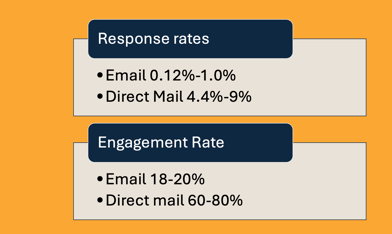
Source: Direct Response Media Group
It’s about using the right channel for the job.
Direct mail consistently delivers:
-
Higher visibility with less competition
-
Stronger engagement and response rates
-
A tangible, more memorable brand experience
-
Better performance when paired with digital campaigns
At National Graphics, we manage the entire process—from print production to targeting and distribution—so campaigns execute seamlessly and reach the right audience. The most effective marketing strategies today aren’t digital-only or print-only. They’re integrated. If your digital outreach isn’t getting the traction you expected, it may not be your message—it may be how it’s being delivered. Direct mail isn’t a fallback. It’s a strategic advantage.
The Personal Touch: Building Trust and Credibility
Establishing trust with customers is crucial in any industry. Through crafting personalized and relevant messages, businesses can build brand affinity and trust before personal interactions by utilizing direct mail. Companies can use direct mail to demonstrate an understanding of their potential client's needs and priorities in many ways that meet regulatory personal information requirements.
Here are just a few examples:
- A financial services firm could send personalized investment insights based on a recipient's portfolio.
- A healthcare provider could share wellness tips tailored to specific demographics or community-based programs available for certain zip codes.
- An insurance firm could provide plans unique to certain areas, such as older homes in Southern California, hail-prone areas like North Texas, or unique life insurance plans that cater to high-net-worth individuals in specific zip codes.
These personalized touches can leave a lasting impression on potential customers, helping to increase brand affinity, build brand trust, and add a personal touch.
Consider these insights from recent studies:
- Since the 1980s, researchers in psychology, computer engineering, and library and information science have published over 100 studies exploring differences in how people read on paper and screens. Before 1992, most experiments concluded that people read stories and articles on screens more slowly and remember less about them. Despite improvements in screen technology, recent surveys still suggest that people prefer paper when they need to concentrate for a long time and remember more of what they read on paper compared to digital screens (Carr).
- Most studies published since the early 1990s confirm that paper still has advantages over screens as a reading medium. Digital devices can prevent people from efficiently navigating long texts and may subtly inhibit reading comprehension. Compared with paper, screens may drain more of our mental resources while reading and make it a little harder to remember what we read when we are done (Carr).
- Studies show that both grade school and college students assume they'll get higher scores on a comprehension test if they have done the reading digitally. Yet, they score higher when they read the material in print before being tested (Urist).
- Psychologists have demonstrated that when adults read news stories or transcripts of fiction, they remember more of the content than if they listen to identical pieces. Researchers found similar results with university students reading an article versus listening to a podcast of the text. A related study confirms that students do more mind-wandering when listening to audio than when reading (Urist).
With most of today's marketing messaging delivered digitally, customers receiving a well-crafted mailer can have a lasting impact. The ability to hold a tangible object on high-quality paper with well-designed images and copy is a differentiator in itself.
The tactile experience of holding that physical artistry is one of many benefits of decision-makers choosing direct mail over digital messages. Potential customers are also far more likely to remember the messages they receive via physical paper than they are from digital messages. The experience increases the perceived value of the message (tangible goods versus fleeting digital ads or deleted emails), holding a physical object adds a more tangible aspect to the company itself, and a well-designed mailer can leave a memorable impression on potential customers who receive it.
Get in touch
If you would like to know more about how our team at National Graphics can help your company leave a lasting impact on current clients and convert more potential clients through data-based direct mail campaigns, contact us today at (805) 695-3116 or email us at info@nationalgraphics.com.